Saturday, August 30, 2008

Happy Birthday to Fred Hampton, Sr.

Sixty years ago today, a baby boy was born in Chicago, Illinois, to a young couple from Louisiana who had migrated north to work in the factories there and raise a family. They called their son "Fred" -- Fred Hampton. Fred grew up in the suburbs, graduated with honors from high school and started attending the local community college on his way to becoming a lawyer. When he joined the N.A.A.C.P. as an organizer, he was so charismatic, he rapidly managed to recruit 500 other young people as new members in a community of only 27,000 residents. Then, he started hearing about the Black Panther Party's ten-point plan of self-determination. And that was all she wrote.

Joining first the national organization and then the newly formed Illinois chapter of the BPP, Hampton shortly drew the attention of the Powers-That-Be all the way to Washington. The FBI's file on the young leader amassed more than 4000 pages over the remaining two years of his life. And they illegally tapped his mother's telephone, too. But that didn't stop Hampton from making his commitment or doing his work.

The first order of business was to successfully broker a non-aggression pact between the most powerful street gangs in Chicago, a notorious seat of such activity. In fact, one of those gangs, the Young Lords, formed an alliance with Hampton's group and a group of anti-racist Appalachian kids -- White no less -- now living in the city, too. The three organizations (pre-dating Jesse's use of the term by decades) called themselves the "Rainbow Coalition." No wonder the FBI was so nerved out!

Late in 1968, the FBI got an agent provocateur named William O'Neal to worm his way into the Chicago-based BPP Chapter, ultimately becoming Hampton's bodyguard and official Judas. He not only passed information, but worked diligently to foment divisions, instigate violence where nobody wanted or needed it, and eventually set up his supposed leader to be murdered by officers of the Chicago Police Department.

After Hampton was prosecuted, convicted and sentenced in the spring of 1969 to two to five years for commandeering a bunch of ice cream bars for the kids in a poor neighborhood, the local gendarmes moved quickly to attack his underlings. They raided the office, destroying as much as they could and beating up any BPP members they could capture. Then Hampton was unexpectedly released on appeal in August, complicating the plan already in motion to decimate his organization while he was incarcerated. It was only a matter of weeks before Hampton had been officially promoted to the Black Panther Party Central Committee and named Chief of Staff as a major spokesperson.

When two police officers were ambushed and murdered in November, only a couple of weeks after another illegal and brutal raid on the BPP, the authorities decided -- without bothering to use a court of law -- that it was the Panthers who were responsible. Two weeks after that, in the pre-dawn hours of December 4th, while Hampton lay in bed with his pregnant girlfriend, sleeping off the secobarbitol slipped into his drink by William O'Neal, Chicago Police Officers stormed their way into the apartment, shooting Fred Hampton to death along with another Panther, Mark Clark. Witnesses -- and there were a goodly number of them -- heard one officer say Hampton was still alive, though barely. Two subsequent shots were fired and the voice was heard to say, "He's good and dead now."

There was, needless to say, never an indictment of any kind related to these crimes, despite the fact that an independent Commission found that the officers murdered the two men without justification or provocation and despite the fact that the City of Chicago did have to pay the families of Hampton and Clark nearly two million dollars a decade later.

This is a horrible story, of course. But you can't really get the full flavor of it all unless you watch "The Assassination of Fred Hampton: How the FBI and the Chicago Police Murdered a Black Panther," the Democracy Now video I'm embedding in this post. Hampton was far more than an effective organizer or firebrand charismatic speaker. He was a full tilt boogie revolutionary who believed in and worked to form a class conscious, multi-racial alliance in the interest of the workers of the United States of America.

This film will answer lots of questions you may have had from time to time and a few you might not have considered yet. It reminded me of things I thought I had forgotten and after I watched it a couple of months ago, I did some homework toward this day, so I could celebrate Fred Hampton's birth and life, work and example.


It's interesting to note that Fred Hampton, Jr., now in his late thirties, who was still inside his mother when she watched the police shoot his 21-year-old father to death before her very eyes, has, it would appear, carried on his father's legacy. Why am I not surprised?


"The Murder of Fred Hampton" - Part 1


"The Murder of Fred Hampton" - Part 2


"The Murder of Fred Hampton" - Part 3

Sunday, August 24, 2008

Whiteness 101

I had an experience this week that was unexpected and, frankly, a little weird.

You know by now, I assume, that I teach sociology at a University and one of my courses this semester (which began this last Wednesday) is a course on Racial and Ethnic Relations. So far, so good, right? I mean, this is what I do, after all. And after twenty years of doing it, I know better by now than to ever think I'm not going to be thrown a curve every once in a while, especially when I've just changed schools. Besides, I'm a pro and I love what I do and periodic shake-ups keep us young (they tell me).

Anyway, my usual way to start my course in Race is to talk about how, according to scientists, "the socially-constructed, political notion of 'race'" is not biological. Then, I ask everyone to put themselves into a big circle in skin tone order (that's right). It isn't easy. They want to be compliant, but it's a request that immediately -- and even considerably -- raises the tension level in the room.

I keep up a stream of patter about the topic to keep us moving forward, bringing in "hair texture" as the next consideration.

"Do we place someone with darker skin and straighter hair BEFORE or AFTER someone with lighter skin and curlier hair?" I ask casually, as if we discuss such things in public all the time.

I don't actually expect them to answer. Nor do they.

Finally, I pull out some one dollar bills and bless each of the darkest five or six with one to keep, explaining that they're getting the money for having the darkest skin. The rest of the students, by now openly vulnerable, look disappointed.

"What's the matter?" I ask, pretending not to understand. "You don't like it when somebody is rewarded for an accident of birth over which they had no control? People that look like me receive far more benefits far more often than this."

Suffice it to say that it's a pretty effective exercise and a very dramatic way to begin the course, make my initial points, and get everybody outside their comfort zone where they will stay for pretty much the remainder of the semester.

The rest of the course is based largely on a process of showing very intense videos and requiring everyone to write out their reactions, which they turn in to me. Then, I pick and choose among them, reading aloud to the group sentences and paragraphs from different reactions (without identifying the writers other than by ethnicity). This gives the African-Americans, Asians, and Latin@s an opportunity to say exactly how they feel without having to worry about being personally attacked. It also gives the students who look like me an opportunity to hear it straight for once, in a setting where I can comment on and further contexualize what they are hearing. The White students can write exactly how they feel, as well, of course, but hearing it read back to them out loud and also contextualized helps them to reconsider their White Supremacist thinking.

So imagine my surprise and consternation Thursday when I walked into the classroom and saw 41 students, almost every one of which was European-American. I cringe to think of it yet.

I had no idea what to do. I had brought my dollar bills and the other things I needed for my usual opening volley. I was excited, though edgy about teaching race for the first time in Louisiana. But I was ready. And now, here I was, flying by the seat of my pants without a shred of warning and no do-overs. Whew!

We all lived through it, more or less, I suppose. I mean, some of the students had already had me for other classes and knew what to expect. In fact, some of them had taken this course expressly to see what I'd do in there. But even they couldn't make me more comfortable and help me through the glitch. I was dumb-struck. And, of course, when I'm nervous and free-falling and talking about race, things can get hairy for the listeners. (I'm smiling here, but I do know -- and I'm sure you can imagine -- I can get rough.)

Later, I went to a couple of former students, young people of color I trust, and asked them what they thought the lack of color among the students in that course is about. Talking with them, I came to realize that students of color in Louisiana have enough to deal with racially without volunteering to sit in a room twice a week listening to racist White folks defend their belief system. They couldn't possibly have imagined what I had in mind. So I got unintentionally hung out to dry.

To make matters worse, my department chair pointed out that while sociology majors at my institution are not required to take Racial and Ethnic Relations, criminal justice majors ARE. So, what I was looking at the other day was primarily a room full of southern European-American law enforcement professionals of the future. Oh, my.

(It didn't occur to me until this moment that the last three public universities I taught for all required that every undergraduate take at least two "multicultural" courses to graduate. Which gives me a really good idea...)

In the meantime, I'm going to have to draft a whole new game plan for this course in this semester. It'll look something like Whiteness 101, I guess.

Saturday, August 16, 2008

Sharde Thomas, Link to the Past and Rising Star

Sharde Thomas & the Rising Star Band, Clarksdale, MS, 2008

If you've been following this week's series on the 21st Sunflower River Blues Festival last weekend in Clarksdale, Mississippi, you've read an overview by now, as well as a post on Willie King and the Liberators. I'd be seriously remiss, however, if I moved on to other subjects without posting specifically about Sharde Thomas & the Rising Star Fife and Drum Band.

Sharde Thomas is the granddaughter of the late Otha Turner, a legend among those who know the blues, captured on film by Martin Scorsese in "Feel Like Going Home", a beautiful portrayal of the connection between the blues and the motherland of Africa. The film opens with Otha Turner and returns to him over and over throughout.


To see Otha with Sharde as a child in a film clip from that video, go here and click on "Watch the Preview." And to catch a glimpse of an even younger Sharde being groomed by her grandfather, check this out:


I just "happened" to watch "Feel Like Going Home" (the first in the renowned PBS series about the blues) two weeks before leaving for Clarksdale. Even on film, watching Otha and Sharde was mesmerizing. So, when I saw her and the band listed on the line-up of performers for Saturday, I made a mental note to make sure I caught their act.

I might have missed them. My running buddies and I had already been at the Blueberry Cafe venue for two and a half hours. We had all had breakfast. And we were ready to head out to see what else was shakin' when we heard the announcement that Sharde Thomas & the Rising Star band would be coming to that stage in a matter of minutes.

It was then that I saw her. Not big as a minute, and having lost all her baby fat, the strikingly beautiful young woman strode through the dining room like the African queen she knows she is, ignoring the crowd at the tables on her way to the back veranda to prepare herself with the band before they entered the door into the performance arena.

Sharde Thomas, Clarksdale, MS, 2008

I was too excited to have any common sense. I followed her like a groupie.

"Are you the little girl that appears with Otha Turner on the documentary?" I asked.

"Yes," she replied, nodding.

"I saw it just a couple of weeks ago," I stuttered, completely disarmed and unnerved. "Your grandfather was a remarkable man and what you're doing is terribly, terribly important. Thank you for carrying on the tradition."

Sharde Thomas was gracious considering that this middle-aged, middle-class-looking White woman was all up in her space right before she had to go on stage.

"Could I have your autograph on this band flyer?" I asked shyly, glad I had something besides my clothes for her to sign because I definitely was not going to let this opportunity pass without putting down some historical marker.

She didn't waste words, but signed the paper and I moved back into the dining room where I tipped Antoinette and Walter to Sharde's presence. They hustled out to take some photos and I made my way into the other room where the standing-room only audience was waiting expectantly. I positioned myself just inside the door they would enter and only about twenty feet from the stage.

Then the door opened and one of the most stirring, resonating sounds I'd ever heard made its way into the room and moved toward the stage in the form of four young people who were carrying Africa like a huge and invisible golden icon, bridging the gap of the past five hundred years as if it was an effortless task. They don't perform. They simply be. And while the skill they display is consummate, it's not their skills that the audience responds to. It's the heartbeat of the Earth pulsating through their instruments and their voices. Their music is not something they make. It's something they are. And the audience moves back and forth between reverent awe and broke loose expressive movement. When Sharde & the Rising Star came down off the stage to lead a processional to the main stage a block or so away, the audience followed them like baby ducks, bobbying and weaving and feeling the joy that buoys a people who have survived what none but them can ever know.


Sharde Thomas & the Rising Star Band, 2005

And lest you think the rivercane fife is the only pipe Sharde can play, listen to this:


Later, I sprang for one of the fifes a family member was selling. I chose the one I wanted out of the few they had brought along and before it was given to me, it was handed to Sharde. She played it, walked around with it for a few minutes, played it some more and then passed it to me. I carried it home like the artifact it is and will treasure it for the rest of my life.

If you happen to be in the neighborhood of Senatobia, Mississippi, for the Turner Family "Everybody Hollerin' Goat" Picnic on August 22nd and 23rd, you can see and hear Sharde Thomas & the Rising Star Fife and Drum band and a lot of other great music for yourself. Otha started hosting these picnics back in the 1950's and they must be something because people travel to get there. There's absolutely no question as to why.
________________________________________________________
The photos above were taken by Walter C. Black, Sr.

Monday, August 11, 2008

Down at the Crossroads

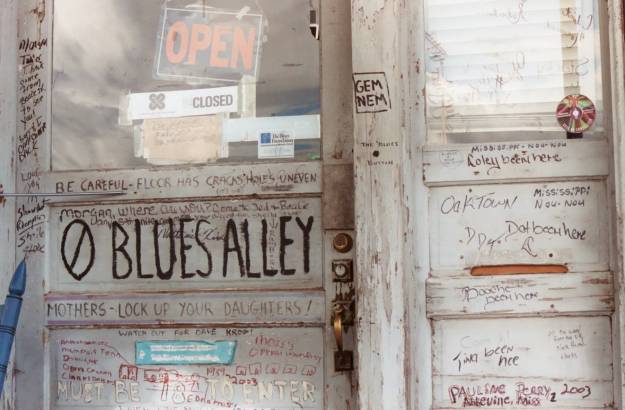
Clarksdale, Mississippi, is situated at the legendary "crossroads" of blues fame, where Highway 51 and Highway 49 meet, the magical spot where, it is said, Robert Johnson claimed to have made a deal with the devil for the gift of playing the blues. It sits deep in the delta, where dark-skinned slaves and later sharecroppers bent their backs to make White men rich. While they worked from "dark to dark" six days a week, when night fell on the weekends, African-American bluesmen donned the black hats and black threadbare suits they made famous and sang the anguish of their people into smoky night air in sweaty, jam-packed shacks called "jukes." If God wouldn't just reach down and lift his people out of their pain or strike down their White oppressors where they stood, at least the blues could touch their bodies and comfort their suffering souls, helping them to survive the longest lasting onslaught against one group of people in human history.

Despite Clarksdale's size (it only has about 20,000 residents even now), multiple generations of unrelieved local agony has produced the likes of Eddie "Son" House, John Lee Hooker, Sonny Boy Williamson, Muddy Waters, Ike Turner, Sam Cooke, and Eddie "Bongo" Brown (one of the Funk Brothers, the group now attributed with almost single-handedly creating the Motown sound -- only to remain anonymous until recent years). Nevertheless, it wasn't until the last decade that the White business community in Clarksdale finally and fully admitted, accepted and even embraced the hamlet's reputation (and capitalistic promise) as the Blues Capitol of the World.

And this weekend, I attended, as you already know, the 21st Sunflower River Blues Festival there.

Needless to say, it was FAR too rich an experience to cover in only one post, so I'll offer you this overview and then post twice more later in the week -- once on Willie King and the Liberators and once on Sharde Thomas and the Rising Star Band, both having stories so fascinating and talent so huge, I just couldn't put it all together without making this a book.

My running buddies and I didn't arrive in Clarksdale until late Friday night, so we decided to forego the evening's activities and just get some sleep, which turned out to be a wise choice because things started early on Saturday and, though you couldn't get it all, you would certainly want to get all you could.

When I first started down East 2nd Street about 8:45 a.m., looking for breakfast, I only saw one man out in the street with me. He was wearing two cameras and a big smile, introduced himself as St. Louis Frank and served as a human directory of immediately helpful information. Like where to get a really great country breakfast for six bucks while listening to live blues (the Blueberry Cafe in the refurbished train depot).

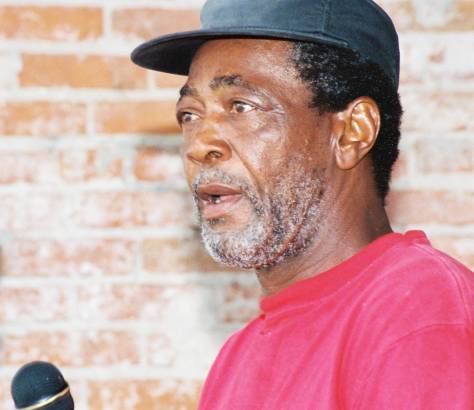
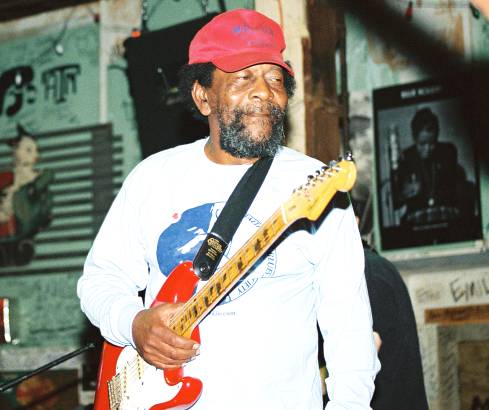
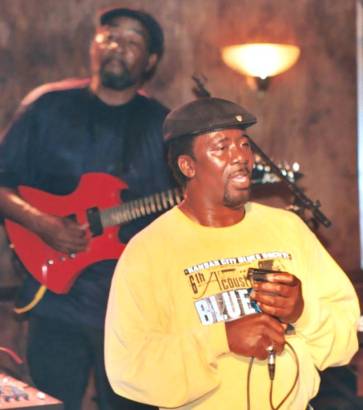
I heard Wiley "Tater" Foster (dressed as the old time bluesman he is), Robert Belfour (dressed to the nines), and Terry "Big T" Williams (above), who turned out to be one of my favorites. I saw Big T at the Depot backing Arthniece "Gas Man" Jones, again later at the main stage, and then ran into him personally at the old Hopson Plantation commissary the following afternoon on my way out of town while he was getting ready to set up to play again. His bass player -- young Lee Williams -- was cloning James Jamerson so well, I wished I had three heads so I could totally focus on each of the musicians on the stage.

Then, just as we were headed for the door, we heard that Sharde Thomas and the Rising Star Band was about to lead a processional to the main stage. A couple of us had seen Sharde and her grandfather, Otha Turner (now deceased), featured on a Martin Scorsese documentary on the blues a couple of weeks ago and I'll write more later in the week about their story, but suffice it to say that this was probably the most electrifying moment of the whole weekend for me. Sharde started learning how to play the sugar cane fife at her grandfather's knee when she was about seven and when he passed, the mantle fell to her. Now, at eighteen years old, backed by a set of drummers, just as he was, she can take you to the mountain and make you jump off. To give you an idea, here's just a taste of Sharde and her brothers and cousins three years ago.

After the Rising Star Band left the stage, I listened to some more Big T and then trailed off to get out of the sun for a few minutes in the Delta Blues Museum. The sun was high by this point and it seemed like a good idea not to go back out in it, so we decided this would be the right time to head over to the Riverside Hotel to meet Frank "Rat" Ratliff who lives there, holds court, and conducts tours for whoever's in town. The rooms are named for the folks who made them famous: Bessie Smith (who died in the building back when it was the local Black hospital), Muddy Waters and Robert Nighthawk (who were staying there when they decided to leave the delta for Chicago), and John Lee Hooker, among others. Rat's mother opened the hotel in 1944 and he's been there ever since, where the blues people stay, where the guests might answer the phone, and where a sign in the busy living room reads simply "Be nice or leave."

At 5:00 p.m., however, we had to be back over to the main stage to catch Willie King and the Liberators. I had heard about Willie from an activist/professor at Delta State who told me that Willie was active in the Civil Rights movement of the sixties and just never quit. While he plays blues all over the world, he still lives in a trailer in Old Memphis, Alabama, which is not even on the map. And he rocked the stage.

Willie has a crowd-pleasing practice of coming down off the stage while he's playing and dancing through the crowd. When he took the tips of my fingers with his and jitterbugged with me for a minute, I got such rush, I was embarrassed. After he and the Liberators finished playing, I got his autograph on the cd I bought and gave him my card, telling him about this blog. "Can I call you?" he asked. "I only live three hours from New Orleans."

I paused, startled. "Absolutely!" I finally blurted.

Later, when I did my homework on him, I decided that if he doesn't call me after all, I will unquestionably call him first. We have things to discuss. But more on him in a later post.

After a rest and a shower, we were back at the main stage for Jimmy Burns, who started late, thank goodness, and got our mojo workin' again. I danced so much Saturday, my feet are still complaining.
But that wasn't the end of the evening. When Jimmy stopped playing, we proceeded to Red's where the bartender's shirt reads "The game's for life. Red's. Clarksdale Mississippi" (And yes I came home with one of those t-shirts.) Red's is a serious juke. Maybe one of the last. Small, filthy, old and worn, with the blues soaked into the very dirt itself. I spent the rest of the night there listening to Terry "Harmonica" Bean, who also got me to dance with him more than once while he was playing harp and when my ride came back to get me at a quarter to one (fifteen minutes before closing), I blew the bluesman a kiss and was glad I wasn't driving myself home because I just might not have gone alone.

The next day, we had a late breakfast at Ground Zero, Morgan Freeman's blues club, and then went on out to nose around the old Hopson Plantation commissary that's been turned into a blues club and museum, as well. Looking at the giant bell that ran the workers' lives and then standing in the safe (as big as a bathroom) where the profits were kept was an odd preparation for what came next.

As we pulled out of town, we came across an old Black church with a cemetary on the river butted right up into a cotton field. It was unnerving to all of us to think about how some of the people buried there probably lived out their days in the field and even in death, couldn't get far. So we spent some time in the drizzling rain, taking photos and communing with those who went before. And then we hit the highway, cranking up the cd player to take us home in a cocoon of the blues.
________________________________________________________
NOTE: All photos embedded and shown in this post were taken by the RatPackStLouis photographers.

Friday, August 08, 2008

Shemekia And Me


I've been crying the blues for the whole last year since I got to Louisiana because it turns out that "the blues" are a little harder than I expected for a busy woman who looks like me to find these days -- even in the South. But I did my work (and then some), went through my trials and tribulations (and some other people's), and now I'm facing another school year right around the corner. So I need a BIG exhale in the worst way and I am deadly ready to paaaa-rty!

Fortunately, it's time for the Sunflower BluesFest in Clarksdale, Mississippi, only five hours away. So my running buddies and I are headed north today and, just like Shemekia Copeland (who'll be there, too), I'm a wild, wild woman. Imah'na find me a coupla good dancers in Clarksdale and wear. them. out.

See ya Sunday, if I can still type. ;^)

Thursday, August 07, 2008

The Rape and Murder of Pvt. LaVena Johnson

I've tried to bring myself to post on this ever since another blogger sent me a notice about the petition calling for a full investigation into the death of 19-year-old Pvt. LaVena Johnson in Iraq in July of 2005. But everytime I think about writing on it, I feel so sad inside, I can hardly lift my fingers off the keyboard.

It's all over the blogosphere, I try telling myself. Nobody really needs me to post on it, too, right? Readers can go here and here and here, for example, and there's WAY more than that.

But I can't walk away. I want to. Some things are just too horrible to think about. The situation of Dr. Siddiqui and her children, for example, has been haunting me all week already. I don't want to focus too closely on the images that are conjured up by LaVena Johnson's broken and wounded body screaming out from the grave that her last night alive was a nightmare.

She had cuts, bruises, scratches, scrapes and teeth marks all over her body. She was hit in the face with a blunt object (possibly a rifle butt), that pushed her teeth in backwards. Her elbow or shoulder were dislocated. She was set on fire. Her genitals had acid poured on them (to destroy DNA evidence?). And she was shot in the left temple by a M-16 (a 40" automatic weapon). See what I'm saying about the images? Imagine how she must have tried to fight off her assailant to wind up in that condition. And she was barely more than five feet tall.

But two things are making me sit down this morning to write. One is that the Army still claims LaVena Johnson committed "suicide." Uh-huh!

And the second is that this petition calling for a Congressional investigation has only 3000 signatures so far. I don't know which fact makes me feel sicker.

I guess it's old news that military leaders lie, especially about sexual assault in the military. And if you pay attention even a little bit, you know that multiple rapidfire tours of combat in Iraq, the lowering of military recruitment standards, and the addition of thousands of highly-paid and historically out-of-control mercenaries with no supervision has escalated violence of all kinds against women -- both in Iraq and after folks come home.

But even though the mainstream media has done almost nothing to publicize the Johnson case, I cannot begin to understand why only 3000 people nationally have stepped forward to demand, if not justice, at least some more believable answers.

The blogosphere is huge. Amy Goodman's on board. So what's going on? Have we become comfortably (or uncomfortably) numb? Are we just overwhelmed with the continuous barrage of garish blood-letting that increasingly surrounds us? Are we scared? Do we just not give a shit? What's the deal?

If Johnson was my daughter, I would hope more than 3000 people in this whole country would care enough to sign a petition. It takes considerably less time to do so than it took to kill LaVena Johnson.
_________________________________________________________
NOTE: Color of Change is also organizing an effort here. Please support all efforts that keep this case alive until LaVena Johnson's death is no longer a mystery.

Monday, August 04, 2008

In Honor and Memoriam

On this day in 1964, the bodies of three young civil rights activists -- Michael Schwerner, James Chaney, and Andrew Goodman -- were found shot to death and buried at the site of a partially constructed dam near Philadelphia, Mississippi. Why had they been murdered six weeks before by the Ku Klux Klan? For the heinous crime of helping African-Americans register to vote.

In the past week, I've posted about hundreds of thousands of slave children in Haiti, peonage in the U.S. in the 20th Century, a young woman being tortured for five years in an Afghani prison run by the U.S., and now this. Doesn't focusing on the horrible bring people down and make them too scared to do anything about it all?

Apparently not.

The poster above, for example, went up less than three weeks after the bodies of Schwerner, Chaney, and Goodman were found. And even today, the work goes on. Mahatma Gandhi said:

"Whenever I despair, I remember that the way of truth and love has always won. There may be tyrants and murderers, and for a time, they may seem invincible, but in the end, they always fail. Think of it: always."

Where Are Dr. Aafia Siddiqui And Her Children?

I received a comment on another post this morning about another horrendous story (why am I not surprised?). Apparently, on March 30, 2003, on her way to the airport in Pakistan, a 30-year-old Pakistani neurological scientist by the name of Dr. Aafia Siddiqui disappeared with her three children, ages four and under. A few days later, NBC reported that Dr. Siddiqui, who had been living with her husband and children in the U.S. for several years, had been arrested for suspicion of facilitating money transfers for terrorist organizations.

An Asian Human Rights Commission Appeal outlines the case and reports:

"Whilst Dr. Aafia's whereabouts remain unknown, there are reports of a woman called 'Prisoner 650'...being detained in Afghanistan's Bagram prison...[who] has been tortured to the point where she has lost her mind. Britain's Lord Nazeer Ahmed, (of the House of Lords), asked questions in the House about the condition of Prisoner 650 who, according to him is physically tortured and continuously raped by the officers at [the] prison. Lord Nazeer has also submitted that Prisoner 650 has no separate toilet facilities and has to attend to her bathing and movements in full view of the other prisoners.

"...[O]n July 6, 2008, a British journalist, Yvonne Ridley, called for help for a Pakistani woman she believes has been held in isolation by the Americans in their Bagram detention centre in Afghanistan for over four years. 'I call her the grey lady because she is almost a ghost, a spectre whose cries and screams continues to haunt those who heard her,' Ms Ridley said at a press conference.

Now, the FBI has admitted that Dr. Siddiqui was "taken into custody" by U.S. "Forces" and taken to a prison in Afghanistan where she has been "held" for the past five years. Her children, I assume, are being "held" elsewhere. There must be some limits, right?

You may sign a petition asking for the release of Dr. Siddiqui and her three children here.

How many men and women of how many nations and cultures do you suppose are being similarly "held" and brutalized around the world? One study found that 40% of the U.S. population believes that torture is appropriate under certain circumstances. What would those circumstances be, one would wonder? Who decides that the criteria for "appropriateness" have been met? What part does human law or human decency play in this process? How would that 40% feel if their loved one were being similarly "held" by an enemy? Would they still deem torture "appropriate" then?
__________________________________________________________
Update: According to The Christian Science Monitor, Dr. Aafia Saddiqui magically appeared in Afghanistan on July 17th, when she was shot in the abdomen by U.S. agents during the process of her arrest on the way to carry out some suicide bombing mission. If you believe this one, I have a bridge you might want to buy.

This is, in my opinion, wonderful news since it means that Prisoner 650 is, if still incarcerated and further wounded, at least living, in the United States, and being represented by a team of lawyers, one of which is Elizabeth Fink, who successfully won the release of Black Panther leader Dhoruba bin Wahad after eighteen years of incarceration for a crime he did not commit.

Sunday, August 03, 2008

Documentary on U.S. Slavery in the 20th Century

Last month, I posted about Antoinette Harrell's work in uncovering slavery in the United States in the 20th Century. This post has gotten a fair amount of attention in various circles, which is always a good thing. But even better is that Harrell has now brought out a 30-minute documentary entitled "The Untold Story: Slavery in the 20th Century".

I've been down to New Orleans twice for showings of the film and now have a copy of the DVD myself which I intend to show in my course on race this fall. This is a story that should be spread. If you have a forum or know of one where this documentary would be useful, I recommend it -- highly.

You may learn more about Harrell, her work, and the documentary, in particular, by visiting her new blog or her new website. And you may order a copy of the documentary for yourself or one for your local library by shooting her an email at afrigenah@yahoo.com.

Quote of the Week


"My continuing passion is to part a curtain, that invisible veil of indifference that falls between us and that blinds us to each other's presence, each other's wonder, each other's human plight."

~~Eudora Welty

Saturday, July 26, 2008

Heatwave Plays The Groove Line


I spend a lot of time every day thinking and talking about sad, ugly stuff. And I'm posting a long piece tomorrow on my friend who takes care of street kids in Haiti. But tonight, I'm remembering me in a purple velour jumpsuit with a BIG silver buckle perched right below my navel dancing under flashing lights to music that sounded like this.

It's hot in Louisiana right now, but Heatwave can make me forget politics, racism, the weather, everything. The first time I saw men like these making moves like these, I was seventeen. It was a Dick Clark touring show. And when the brothas let loose, so did I. Mm-mm-mm! I may be old, but I ain't dead...

Wednesday, July 23, 2008

Detroit, I Do Mind Dying...


In the wee hours of the morning on this day in 1967, police executed what they thought would be a routine roust on an after-hours club in Detroit, Michigan, only to find more than eighty patrons. Stuck in the middle after they were already on the premises, the officers couldn't just leave, so they arrested them all. The rest is history in the form of a five-day nightmare that eventually saw more than 4000 arrested and left 43 dead. If you don't know the story, you can watch a documentary on it online. You can also do an interesting follow up by reading Detroit, I Do Mind Dying, a book originally published in 1975 on the Black revolutionary union movement.

On the 26th, while the uprising was still in full sway, H. Rap Brown, then head of the Student Non-Violent Coordinating Committee (SNCC), was arrested in Cambridge, Maryland, for declaring in a speech he was giving, "Black folks built America, and if America don’t come around, we’re going to burn America down."

On the 27th, police in Chicago, Illinois, refusing to arrest a White man responsible for the death of a young African-American sparked a similar explosion in that midwestern city. According to the Coroner's report, "Five days of terrible hate and passion let loose, cost the people of Chicago 38 lives..., wounded and maimed several hundred, destroyed property of untold value, filled thousands with fear, blemished the city and left in its wake fear and apprehension for the future..."

What did we learn from all this? That there is a raging sea of frustration just under the surface in the United States that will always find a blow hole until we address what is producing it. And that the authorities are prepared to do whatever it takes to keep the oppressed down. Why do I put it like that? Because after they restored "order," nothing was done to change the social problems that caused the violence in the first place.

It has been said that violence is the language of the inarticulate. I would argue that it's the language of the unheard. We better listen.

________________________________________________________

NOTE: The information in this post came from This Week in History, a wonderful resource for learning our real history.

Sunday, July 20, 2008

I Read the News Today...Oh, Boy...

I'm working on several posts just now and something weird is going on with YouTube today for some reason. So while you're waiting, I'm gonna give you some links to keep you busy.

1) To start with, you might want to find out what Mike Whitney says really happened to free Ingrid Betancourt from the rebels in Colombia. It involves the payment of $20 million for one thing, but that's not even half of the back story. I wonder what we'd do without new media sources like Counterpunch, Truthout, Znet and the many others that have risen to keep us from being buried in bullshit. If you're not supporting one or more of these to the extent you're capable, then we'll have you to thank when we're completely left to the mercy of Big Brother's NewSpeak.

2) The Field Negro, as usual, has some pithy words on another current news flap: re-visiting the use of the word "nigger" (aka "the n-word"*) by Jesse Jackson, for one, but also creating a tizzy on "The View" when the discussion turned to why African-Americans can use the word, but White folks can't.

(Criminy. I'm not sure anybody that needs an explanation deserves one.)

3) Anyway, a friend and fellow sociologist (and freedom-fighter) tipped me this morning to a piece Hans Bennett did for The Dissident Voice (another of those important and worthy to be supported alternative news sources) containing an interview of Claude Marks, a Black activist who, among others, was arrested and tortured in the 1970's for -- basically -- being a Black activist. Marks has spent decades now making films and directing an archive of materials documenting and describing the use of law enforcement, the criminal justice system, and torture against people of color. Of particular interest to me is the way the system is now going back to thirty-year-old cases, re-arresting people, and taking them back into court using "confessions" already established as having been acquired by the use of physical torture. Does the public have no limits to what it will accept?

4) And lest you think torture and other horrible acts of violence are only visited on those who "deserve" it, Macon D. at Stuff White People Do presents Andrea Gibson's poem about White history. If it doesn't make you sad, then you need to go to the time-out corner until it does.
____________________________________________________
* I am letting Ta-Nehisi Coates give me permission to use the word "nigger" when referring to the word. This has been bothering me for years. I maintain that White people must NEVER use the word to refer to someone of African descent -- either directly or indirectly -- even to each other in private and I do my part to make sure they don't. I believe, in spite of the word's history, that it is NOT my business to try to instruct people of color on whether or not (or how) they use it. But when I'm trying to ram home a point in an anti-racist speech or lecture and have to use "the n-word" as a phrase, I feel like I've just reverted to baby talk. I don't even talk baby talk to babies. Thank you, Ta-Nehisi. You freed me a little bit more and God knows, I can always use more Consciousness-raising.

NOTE: The graphic featured above is on postcards available from the Syracuse Cultural Workers Collective.

Thursday, July 17, 2008

Dog the Bounty Hunter, Part 3


Last month, I blogged here and here in solidarity with the Afrosphere Action Coalition's campaign to stop "Dog" Chapman from returning to the tv screen after his refusal to address his openly racist past(?) attitudes and behaviors.

Now, the AAC has issued the following statement:

After contacting the A&E Network and some of its advertisers about the return of Duane “Dog” Chapman’s show “Dog The Bounty Hunter” to the air waves, the Afrosphere Action Coalition released a statement on June 17th “expressing our dissatisfaction with the network’s decision." In anticipation of the planned return of the show, we also hosted the Day of Blogging for Respect in Media.

A&E’s regrettable reply was predictable and dismissive. Nonetheless, the AAC and our constituents remain undeterred in our opposition to the show's return as “Dog” has never owned up to what he actually said, nor demonstrated any change or shown action to make amends; but instead simply put on a PR show with the desire of maintaining commercial viability.

As the new season of “Dog The Bounty Hunter” airs Wednesday, July 16th, the AAC will be monitoring the program for those advertisers who have chosen to put their brands at unnecessary risk by propping up the position of a public figure who engages in racial denigration; after which we will continue to alert the broader public about those who choose to stand for respect of all peoples in media, versus those corporations standing simply for what they perceive will advantage the bottom line, above all else.

The AAC has and continues to “urge A&E in the strongest terms to reverse course and withdraw their support for Duane Chapman and the 'Dog the Bounty Hunter' show. Until A&E does so, we have no alternative but to inform the viewing public and urge them to withdraw support from A&E and its advertisers. If Duane Chapman had come clean about his racially demeaning behavior and attitudes, thereby demonstrating real sincerity towards actual change, perhaps there may have been a place for him again in the public square. But on the record A&E has set before us, he has simply gotten a vacation and we cannot accept that he is again receiving a platform and further financial reward.”

It was pointed out to me about another matter in Louisiana recently that one of the problems those of us who push for social change have is that we often quit pushing when we don't win. Unlike our opponents who never sit down, no matter how badly they lose. It's a tactic we need to learn. Slow and steady wins the course.

To get on the bandwagon, go to BlackPerspective.net.

Sunday, July 13, 2008

Soulfege Takes Back the Mic

Sometimes, being technologically behind the times is a real kick in the pants. Normally, I don't care all that much. When I finally ordered a phone with a camera the other day for the first time, I was chagrined to realize that my choices were few if I (a) don't listen to music on my cell phone and (b) spend SO much time online already, I'd rather be nibbled to death by a duck than carry the internet in my purse. The salesgirl was kind of embarrassed for me.

Don't get me wrong. I'm light years ahead of a lot of folks, but I just stay shuffling along behind the wave -- well behind it. And while I'm usually just fine, thanks, hanging around back here with the not-very-with-it older folks, sometimes I feel the pinch. Like tonight.

Thanks to this blog, I've been offered the opportunity to download a new album by a group that's shortly going to be even bigger than they already are and I don't have MP3 capability. It's enough to make me wanna buy an iPod.

The group is called Soulfege. The album is Take Back the Mic. And you've probably already seen Derrick Ashong (aka DNA), one of the band members, on YouTube, if you're one of the more than a million people that have watched him explain health care to an antagonistic interviewer at an Obama/Clinton debate last winter.

Ashong, a 32-year-old Harvard graduate, is quite a guy, as you can see by watching this:


But Soulfege is a long way from being an interesting, talented guy backed up by some adequate hangers-on. Soulfege is a record label's dream: highly attractive and super-talented songwriter/performers putting out a reggae/hip-hop/funk/West African highlife blend and greatly committed to a serious political agenda. Shades of Bob Marley! Have we been needing this or what?

If you're like me, you need to hear a group before you want to read about them, so trip on over to MySpace and check out songs with titles like "From the Soul," "[What Would You Give] To Be Free?" or the electrifying "Damoshi" (Stand Up). Then, you can read about them on their website or in The Boston Globe or in Vanity Fair. Clearly, Soulfege is on the move. I mean, their music is already in more than fifty countries. So, don't be one of the last ones on your block to know.

And for those of you who, unlike me, are digitally endowed, the band's new album Take Back the Mic will be available on iTunes for download beginning Tuesday, July 15th. I'm gonna have to wait till it comes out in a store.

*Sigh.*

Thursday, July 10, 2008

Louisiana Outlaws the Noose

Probably everybody and her sister knows this already, but I've been blogging everyday for a while, moved from one apartment to another, and started teaching again four afternoons a week, so I haven't exactly been on top of what's happening. Even forty miles away in Baton Rouge.

Anyway, while I was busy with other stuff, Louisiana State Representative Rickey Hardy (shown above, tying a noose while testifying on his bill) drafted a bill making it a crime for a person to place a hangman's noose or a picture of one on another person's property or on public property with "the intent to intimidate." The bill was unanimously passed in both the House and the Senate and it was signed into law by Governor Bobby Jindal a week ago. Will wonders never cease?

And all it took was the March on Jena. A bargain at twice the price.

But let's remember what six young men had to suffer through for this to happen. After hundreds of years of institutionalized racism in this state, African-American high school boys in a tiny little town in north Louisiana sat under a tree reserved for "Whites only" and it was their frustration and their courage and their rage and their willingness not to back down that made this happen. The world has moved on, but believe you me, their lives and their psyches will never be the same for the fire they had to walk through.

The March was a historical moment, but it was those six boys who paid the price. Here's to the Jena Six. May they always be remembered for their contribution to the process of liberating their people. I appreciate what Rep. Hardy did and I'm delighted, of course, that the legislature in this state unanimously supported his action. But I'm in awe of what those six young men took upon themselves, knowing they could die or go to prison for it. They joined the ranks of those who went before them, sacrificing their own comfort -- with or without a plan -- because they would no longer accept that "Blacks" should keep "their place."
_________________________________________________________
The photo above was taken by Bill Feig of the Baton Rouge Advocate and also appeared in the Jet Magazine, which is how I found out about this at all.

Wednesday, July 09, 2008

Two Down and One To Go


Albert Woodfox, the Black Panther Party leader who spent thirty-six years in solitary confinement for a crime he didn't commit, famous around the world as one of the Angola Three, finally had his conviction overturned yesterday. I had to find this out from the Associated Press on Google News rather than through the local papers. Why am I not surprised?

I'm posting this powerful YouTube video featuring Richie Havens playing "Freedom" in honor of Woodfox and Herman Wallace, the remaining member of the triad, whose case is still pending. Maybe someday they can watch it together on the outside of the prison they were intended to die in -- alone.
_______________________________________________________
Update: The State will appeal this decision. Apparently guilt or innocence are not in question here. Woodfox is, after all, a Black Panther. One doesn't need a court of law to convict him of that.

Sunday, July 06, 2008

Dialogue

The following comment popped up on a year-old post last night. I have decided to re-print it here because I suspect that it speaks for many people that look like me in this country. Since the writer chose to write this much, I am publishing it all, out of respect for her expression of obvious frustration. This is what One Voice That Matters wrote:

"I guess I must live in a different world than most of the people on these sites. I have no tolerance for people of any color abusing others. I also think that what is fair for one is fair for the other. KKK, skinheads, Aryans are scum. Every now and then they try to surface here. but I know there are 'black' sites that are just as racist, promoting racial violence also.

"I live in a 100% 'white' town.There were never any slaves or plantations or anything of that type of life in this state. Most blacks came here with the Indians and many blacks have roll cards from the Indian ancestors. No 'black' people choose to live here; it is a basic farm and ranch community with very good people. Most just go on with life's daily chores and rarely think about the 'outside' world. Yes, the community is aware of the violence in the big city and most are glad we live where we do.

"North of us is a community of black people and they are basically the same. Farmers and ranchers, good people. They come into our town and shop and we buy produce, cattle, etc., from them. Yes, there is racism from both sides from time to time, but we respect each other as humans. I have no problems with who I live around. I would rather live around those good people in the black community than white trash I know. I usually find that if a black person respects you, they are your friend for life. My mother taught me that long ago.

"My mom tells a story about when my grandmother had a new baby, mom and her siblings were all too small to wash clothes. Their neighbor lady who was black came over and washed all the clothes for the kids. She brought her baby over and mom took care of her baby. Mom said that Granny would do the same for the neighbor. She didn't know what prejudice was as a child. My mom and dad's parents were reeeeallyy poor and so was everyone around them. Everyone helped each other and no one thought anything about it. Mom worked later years with many of the black children she played with and loved all of them, they in turn loved my mom like a sister. I had the privilege as a teacher teaching their grandkids. They were well mannered good kids with ambition to be achievers like their folks. On days they did not want to do the schoolwork, all I would have to do is say Grandma's name and all changed!

"It seems the larger our closest big city gets, the more racism we see. Most of it is coming in from the outside: gang activity with the teens. In some ways we have all lost out with traditions from the old days when times were hard. From the way things look, we are all going to be poor again like the 30's and learn to respect each other like my mother's generation.

"I do not understand slavery or abuse in any culture. I see post[ed] that 'all white people are the same.' No, I am not. Just like all black people, [C]hinese people, [L]atinos are not the same. It would be like saying all dogs are the same. They all have 4 legs and wag their tongue.

"I could care less about Hollywood, New York or what rich people do. I am sad when a child is killed of any color, when someone is disrespectful of the elderly or the unfortunate. I have respect for people with pride in themselves and what they do for the good of the world, no matter the color. My family history is rich with people of many nations and colors. They left me to make a better world for all they believed in and died for coming to America for their chance of a dream. The one I live.

"No, I am not 'rich' in material things but count myself a millionare in the life I was chose[n] to live here in this wonderful nation. I have been discriminated against as a woman, [for] my age, my looks, my lack of wealth, my accent, and, yes, even my color! Even sometimes [for] my intelligence and savvy by hard line men who didn't want to deal with a smart woman. I know that the 'rich' white majority [that] runs this place could care less about me unless I can pay taxes. My one vote won't swing any election and I will never be in a position of 'power' to run this nation but maybe if I can change enough lives in the classroom and build a dream, my one voice will not be wasted."


And this was my response:

I'm a little surprised to find someone commenting on a post about a topic not being discussed too much anymore -- and long after I posted it. I can't help but wonder how you got here, One Voice That Matters. :^)

In any case, I haven't time to write as much as you did.

However, I would suggest several things for you to consider.

First of all, my definition of racism and yours are not the same. If you'll read this post, even older than the one on which you commented, you'll see what I mean.

Secondly, there ARE no states in the U.S. that have not shared our history of racist and ethnic oppression. Pick up "The People's History of the United States" by Howard Zinn and you'll likely find plenty there. Or you can tell me the state you live in and I may be able to suggest some other sources. The Southern Poverty Law Center keeps an up-to-date list of hate groups in the present, if that interests you at all. And if you look up the prisons in your state, even a quick look at their population statistics will demonstrate how different life is for people of color wherever it is you live. Unless, of course, you're prepared to argue that people of color just do more crimes because...well...they're just like that. But I don't think you would even think such a thing, let alone say it.

You write about how beautifully everybody used to and still does get along in your state, but I wonder what the people of color (African-American, Latin@, and Native American) that live there would have to say about that. I doubt that you know. The fact is that individuals can have loving relationships across "color lines" in this country, but the color lines are the result of White control or they wouldn't exist at all. And anyway, individual loving relationships don't change the institutionalized nature of the oppression against people of color here.

I've never suggested that all White people are the same. But I have written that, because the default position in the U.S. is White Supremacy, all people in the U.S. who look like me are infected with the disease of racism, whether we recognize and acknowledge it or not. Most of us don't admit it. Most of us don't even realize it. But, just like Prego, it's in there. Tim Wise' book "White Like Me: Reflections on Race by a Privileged Son" is very good on this.

Finally, you write that you're trying to change lives in the classroom. Yet you don't seem to be very in touch with the extraordinary and peculiar psychological, emotional, and economic violence that continues to do great damage to people of color from coast to coast in this country (and even beyond its borders). Unfortunately, what this means is that your students (all White, from what you say) are very likely going to wind up with the same old mindset White folks in the U.S. have always had. How could it be otherwise when you yourself have no better understanding than you do?

You sound like a well-meaning person. And teachers know how to learn stuff. Your responsibility, should you accept it, is to get the information you're missing, so you can help us go somewhere new in this country. Before it's too late.

Thanks for writing. I believe you're seeking to learn something already. And if you seek with your heart open, you'll find.
________________________________________________________
The poster featured above is available from the Syracuse Cultural Workers Collective.

Saturday, July 05, 2008

Passin' It On


I rarely post somebody else's work in any length, but I'm making an exception today of something I received in an email this morning. Perhaps I wouldn't, but I spent last evening until the wee hours watching a video I'm going to post next month about the murder of Fred Hampton, the Black Panther Party leader, and transcribing his speeches so I could post them, too. The upshot was that I am a little tired this morning, feeling quiet and a little stormy inside, and when I read this, I just wanted to share at least some of it. So here it is:


Some thoughts on "patriotism" written on July 4
by William Blum (www.killinghope.org)

Most important thought: I'm sick and tired of this thing called “patriotism.”

The Japanese pilots who bombed Pearl Harbor were being patriotic. The German people who supported Hitler and his conquests were being patriotic, fighting for the Fatherland. All the Latin American military dictators who overthrew democratically-elected governments and routinely tortured people were being patriotic – saving their beloved country from “communism.”

General Augusto Pinochet of Chile: “I would like to be remembered as a man who served his country.”[1]

P.W. Botha, former president of apartheid South Africa: “I am not going to repent. I am not going to ask for favors. What I did, I did for my country.”[2]

Pol Pot, mass murderer of Cambodia: “I want you to know that everything I did, I did for my country.”[3]

Tony Blair, former British prime minister, defending his role in the murder of hundreds of thousands of Iraqis: “I did what I thought was right for our country.”[4]

I won't bore you with what George W. has said.

At the end of World War II, the United States gave moral lectures to their German prisoners and to the German people on the inadmissibility of pleading that their participation in the holocaust was in obedience to their legitimate government. To prove to them how legally inadmissable this defense was, the World War II allies hanged the leading examples of such patriotic loyalty.

I was once asked after a talk: “Do you love America?” I answered: “No.” After pausing for a few seconds to let that sink in amidst several nervous giggles in the audience, I continued with: “I don't love any country. I'm a citizen of the world. I love certain principles, like human rights, civil liberties, democracy, an economy which puts people before profits.”

I don't make much of a distinction between patriotism and nationalism. Some writers equate patriotism with allegiance to one's country and government, while defining nationalism as sentiments of ethno-national superiority. However defined, in practice the psychological and behavioral manifestations of nationalism and patriotism – and the impact of such sentiments on actual policies – are not easily distinguishable.

Howard Zinn has called nationalism “a set of beliefs taught to each generation in which the Motherland or the Fatherland is an object of veneration and becomes a burning cause for which one becomes willing to kill the children of other Motherlands or Fatherlands.”[5]...

Strong feelings of patriotism lie near the surface in the great majority of Americans. They're buried deeper in the more “liberal” and “sophisticated,” but are almost always reachable, and ignitable.

Alexis de Tocqueville, the mid-19th century French historian, commented about his long stay in the United States: “It is impossible to conceive a more troublesome or more garrulous patriotism; it wearies even those who are disposed to respect it.”[7]

George Bush, Sr., pardoning former Defense Secretary Caspar Weinberger and five others in connection with the Iran-Contra arms-for-hostages scandal: “First, the common denominator of their motivation – whether their actions were right or wrong – was patriotism.”[8]

What a primitive underbelly there is to this rational society. The US is the most patriotic, as well as the most religious, country of the so-called developed world. The entire American patriotism thing may be best understood as the biggest case of mass hysteria in history, whereby the crowd adores its own power as troopers of the world's only superpower, a substitute for the lack of power in the rest of their lives. Patriotism, like religion, meets people's need for something greater to which their individual lives can be anchored.

So this July 4, my dear fellow Americans, some of you will raise your fists and yell: “U! S! A! U! S! A!” And you'll parade with your flags and your images of the Statue of Liberty. But do you know that the sculptor copied his mother's face for the statue, a domineering and intolerant woman who had forbidden another child to marry a Jew?

“Patriotism,” Dr. Samuel Johnson famously said, “is the last refuge of a scoundrel.” Ambrose Bierce begged to differ: “It is,” he said, “the first.”...
_______________________________________________________
NOTES:
[1] Sunday Telegraph (London), July 18, 1999
[2] The Independent (London), November 22, 1995
[3] Far Eastern Economic Review (Hong Kong), October 30, 1997, article by Nate Thayer, pp 15 and 20
[4] Washington Post, May 11, 2007, p.14
[5] "Passionate Declarations" (2003), p.40
[6] ZNet Magazine, May 2006, interview by David Barsamian
[7] "Democracy in America" (1840), chapter 16
[8] New York Times, December 25, 1992
____________________________________________________________________
The poster featured above is available from the Syracuse Cultural Workers Collective.